Bookkeeping services Ontario small businesses need in 2026 have become one of the highest-ROI investments a growing company can make — and most owners are still underestimating the cost of doing it wrong.
According to Kapoor CPA, CRA penalties for poor record-keeping start at $1,000 and escalate quickly during audits. In 2026, the CRA has increased its expectations around digital record-keeping, HST tracking accuracy, and audit-ready documentation. Professional bookkeeping is no longer a back-office function — it is a front-line compliance and cash flow tool.
This guide explains exactly what bookkeeping services in Ontario cover in 2026, what to look for in a provider, how much it costs, and how Corporate Empire delivers CRA-ready books for Ontario small businesses every month.
August 2026 Quick Facts: Best bookkeeping services: flat-rate $350–$600/month | Ontario HST rate: 13% (5% GST + 8% provincial) | CPP maximum pensionable earnings 2026: $74,600 | CRA record retention: minimum 6 years | ROITC expires December 31, 2026 | Book a free bookkeeping consultation →
Bookkeeping Services Ontario 2026: What They Cover and Why It Matters More Than Ever
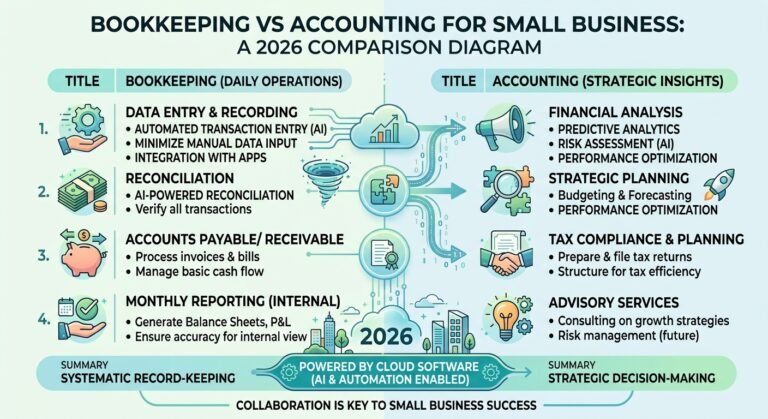
The scope of bookkeeping services Ontario businesses need in 2026 goes well beyond entering transactions into software. Here is what a complete monthly bookkeeping engagement delivers:
CRA bookkeeping requirements: Canada Revenue Agency — Keeping Records (canada.ca) — official CRA guidance on minimum record-keeping requirements, retention periods, and electronic record standards for Canadian businesses in 2026.
| Service | What It Includes | Why It Matters in 2026 |
|---|---|---|
| Transaction Recording | Every sale, expense, bank transfer, and owner draw recorded and categorized | CRA requires complete records supporting every income and deduction claim |
| Bank Reconciliation | Bank, credit card, and payment processor feeds matched every month | Catches errors, fraud, and missing transactions before they compound |
| HST/GST Filing | Quarterly or annual HST return preparation and CRA remittance | Late HST penalties: 1% of balance owing + 0.25%/month up to 12 months |
| Payroll Processing | CPP/EI deductions, T4 preparation, CRA payroll remittances | 2026 CPP max pensionable earnings: $74,600 — requires precise monthly calculation |
| Monthly Financial Reports | Income statement, balance sheet, and cash flow delivered by the 10th | Gives you real financial visibility — not a quarterly guess at profitability |
| Year-End Package | CPA-ready year-end file with T4/T5 summaries and supporting schedules | Clean year-end books cut your CPA’s fees significantly |
The Ontario 2026 Tax Changes Every Small Business Must Know
Two 2026 Ontario budget changes directly affect your bookkeeping setup this year — and most small business owners are not tracking them.
1. Enhanced CCA (Capital Cost Allowance) Write-Offs: Eligible equipment purchased in 2026 can be written off more aggressively under enhanced CCA rules — but only if properly documented at the time of purchase. Assets must be correctly categorized, dated, and linked to the appropriate CCA class in your books. Miss the documentation and you miss the deduction permanently.
2. Regional Opportunities Investment Tax Credit (ROITC) Expires December 31, 2026: For Ontario businesses in designated slower-growth regions, the ROITC provides a refundable tax credit on qualifying capital expenditures. Capital expenditures incurred on or before December 31, 2026 remain eligible. If you are considering equipment purchases or building improvements — this is a real deadline with real money attached. Your bookkeeper must categorize and date these expenditures correctly before year-end.
2026 Ontario budget bookkeeping impact: Kapoor CPA — Small Business Bookkeeping Services Ontario 2026 — analysis of how 2026 CCA changes and ROITC deadline affect Ontario small business documentation requirements.
How to Choose Bookkeeping Services Ontario Businesses Can Actually Rely On
Not all bookkeeping services Ontario businesses hire deliver the same quality. Here are the six criteria that separate reliable providers from those that create more problems than they solve:
Ontario uses HST at 13% (not GST only). The input tax credit rules, filing frequency thresholds, and payroll remittance schedules are Canada-specific. A bookkeeper trained on US accounting software or a generic platform that doesn’t understand CRA requirements will create compliance gaps that show up as penalties — not as invoices.
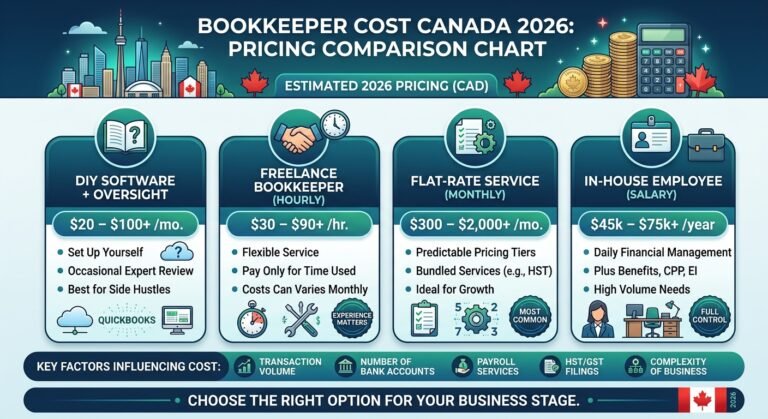
Hourly billing creates unpredictable month-to-month costs and misaligned incentives. The best Ontario bookkeeping services charge a flat monthly fee — $350–$600/month for most small businesses — so you always know what you’re paying and your bookkeeper is incentivised to be efficient, not to run the clock. Flat-rate pricing is the current industry standard for quality providers.
In 2026, the CRA increasingly expects digital record-keeping. QuickBooks Online and Xero are the two dominant platforms for Canadian small businesses — certified advisors on either platform work faster, produce cleaner audit trails, and integrate with your bank feeds and HST filings automatically. Providers using local desktop software or spreadsheets are a 2015 solution for a 2026 compliance environment.
Your financial statements need to arrive on a predictable schedule — by the 10th of the following month is the industry benchmark. If your bookkeeper delivers reports “whenever they’re ready,” you are managing your business on data that is 45–60 days old. Decisions about hiring, pricing, and cash flow require current financial visibility.
Bookkeepers record transactions. CPAs interpret them for tax and strategic purposes. The best Ontario bookkeeping services have CPA oversight built in — either a CPA reviews the books monthly or the bookkeeper operates under a CPA firm’s supervision. This is the layer that catches classification errors before they become audit findings.
A good bookkeeper does not wait for you to ask about an upcoming HST deadline. They notify you 2–3 weeks before, confirm the filing amount, and handle the CRA submission on your behalf. If you are routinely discovering CRA late-filing notices, your bookkeeper is not doing their job — they are just recording transactions.
How Much Do Bookkeeping Services in Ontario Cost in 2026?
The cost of bookkeeping services Ontario small businesses pay in 2026 depends on transaction volume, whether payroll is included, and the complexity of your chart of accounts. Here is the current market range:
| Business Type | Monthly Cost Range | What’s Included | Delivery Standard |
|---|---|---|---|
| Sole Proprietor / Freelancer | $350–$500/month | Transactions, reconciliation, HST, annual T1 support | Reports by the 10th |
| Incorporated SMB (1–5 employees) | $500–$800/month | Full bookkeeping + payroll + HST + year-end T2 package | Reports by the 10th |
| Growing SMB (5–20 employees) | $800–$1,500/month | Full bookkeeping, multi-account payroll, HST, accounts receivable tracking | Reports by the 10th + cash flow forecasting |
| In-House Full-Time Bookkeeper | $4,500–$7,000/month | Salary + CPP + EI + benefits — plus management overhead | Only viable above $5M revenue |
The most common financial mistake Ontario small business owners make is comparing outsourced bookkeeping costs to “zero” — as if doing it themselves has no cost. The real comparison is 5–10 hours per month of the owner’s time, the cost of CRA penalties from errors, and the opportunity cost of decisions made on inaccurate books.
See our bookkeeping and financial services at Corporate Empire — or book a free consultation and we will review your current books, identify any CRA compliance gaps, and give you a fixed monthly quote.
Frequently Asked Questions
Do I need a bookkeeper if I am a sole proprietor in Ontario?
The CRA requires every business to maintain adequate financial records supporting all income and deductions — regardless of business structure. You are not required to hire a bookkeeper, but you are required to maintain those records. Most Ontario sole proprietors find that once their business has more than 20–30 transactions per month, or once they have registered for HST, the time cost of self-managed bookkeeping exceeds the monthly cost of professional services. For sole proprietors, professional bookkeeping in Ontario typically starts at $350/month — often less than the value of the CRA deductions they were previously missing.
What is the difference between bookkeeping and accounting in Ontario?
Bookkeeping records what happened — transactions, reconciliations, payroll, HST filings. Accounting interprets it — financial statements, T2 corporate tax filing, deduction strategy, and CRA audit representation. Bookkeeping services Ontario businesses engage monthly are the foundation that your accountant or CPA builds on at year-end. Clean books from a professional bookkeeper significantly reduce your CPA’s time at year-end — and therefore your year-end accounting fees.
How long do I need to keep my financial records in Ontario?
The CRA requires Ontario businesses to retain financial records for a minimum of six years from the end of the last tax year to which they relate. This includes all receipts, invoices, bank statements, payroll records, and HST return supporting documents. In 2026, the CRA increasingly expects these records to be maintained digitally — scanned receipts, digital bank feeds, and cloud accounting software are all acceptable and in many cases preferred. Physical records stored in boxes are still technically compliant but create audit risk if they are disorganized or incomplete.
Does Corporate Empire use QuickBooks Online or Xero?
Corporate Empire works in both QuickBooks Online and Xero — the two leading cloud accounting platforms for Canadian small businesses. We are certified advisors on both platforms. If you are already using one, we work in your existing system. If you are starting fresh, we will recommend the right platform based on your business type, transaction volume, and whether you have employees requiring payroll processing. Both platforms integrate directly with major Canadian banks, CRA’s business portal, and HST filing requirements.
How do I get started with bookkeeping services in Ontario?
The first step is a free consultation where we review your current books, identify any CRA compliance gaps, and determine the right monthly scope for your business. Most Ontario businesses that come to us have at least 3–6 months of catch-up bookkeeping to complete before going onto a clean monthly cycle — we handle that as part of onboarding. Our bookkeeping services Ontario clients receive include a fixed monthly fee, delivery of financial statements by the 10th, HST/GST filing, and a CRA-ready year-end package for your CPA. Book your free consultation at corporateempire.ca/contact.
Get a Free Bookkeeping Consultation for Your Ontario Business
We review your current books, identify CRA compliance gaps, and give you a fixed monthly quote. No obligation — no surprise fees.