
Getting bookkeeping services Ontario small business owners can actually afford is less about finding the cheapest hourly rate and more about avoiding the four or five mistakes that quietly cost thousands at tax time.
Most owners we meet are not disorganised. They are simply doing the books at 11pm on a Sunday, in a spreadsheet, from memory.
Here are the nine facts that matter before you hire anyone.
What Bookkeeping Services Ontario Small Business Owners Actually Get
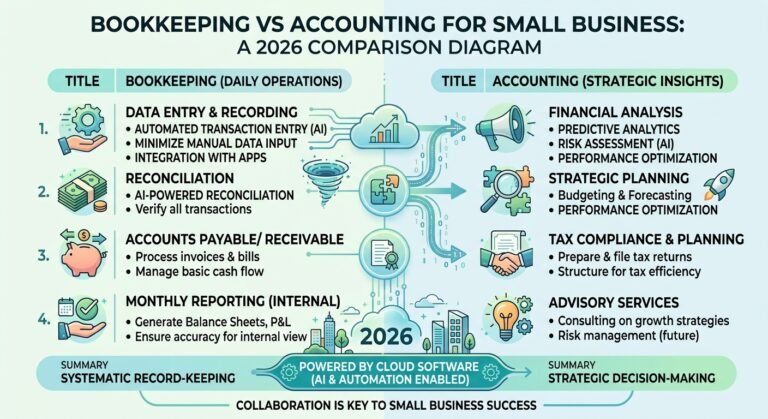
1. Bookkeeping and accounting are not the same job
A bookkeeper records what happened: transactions, reconciliations, payables, receivables, payroll entries, HST tracking.
An accountant interprets it: year-end filings, tax planning, corporate returns, structure advice.
You need clean books before an accountant can do anything useful. Paying an accountant to sort a shoebox is the most expensive way to get bookkeeping done.
2. Monthly is the standard, not quarterly
Quarterly books mean you find out about a cash flow problem eleven weeks after it started.
Monthly reconciliation catches duplicate charges, missed invoices and payment errors while they are still fixable.
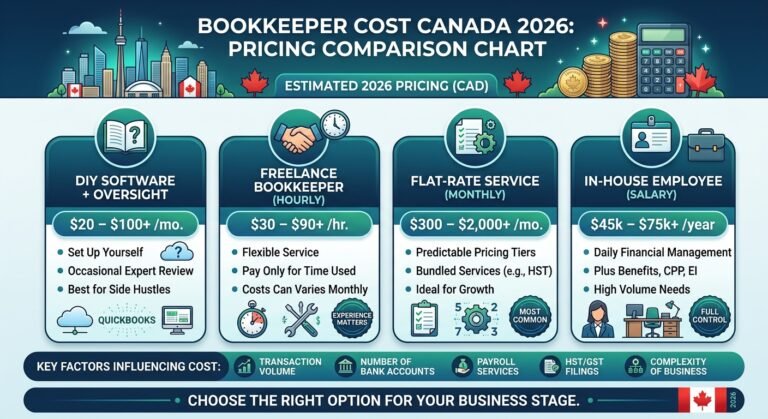
3. Expect $300 to $1,200 a month in Ontario
Realistic 2026 pricing for an Ontario small business:
- Sole proprietor, low volume: $250 to $450 per month
- Incorporated, under 200 transactions: $450 to $800 per month
- With payroll and HST filing: $700 to $1,200 per month
- Catch-up work: $500 to $2,500 one time, depending on how many months are behind
Anything advertised well below these ranges usually means data entry only, with no reconciliation and no review.
HST, Payroll and the Deadlines That Bite
4. You must register for HST once you cross $30,000
The small supplier threshold is $30,000 in taxable revenue over four consecutive calendar quarters. Cross it and registration is mandatory, not optional.
Many owners cross it mid-year without noticing and end up owing HST they never collected.
Current rules and thresholds are published by the Canada Revenue Agency and are worth checking annually.
5. Filing frequency depends on revenue
Smaller registrants generally file annually, mid-sized quarterly, and larger businesses monthly. Your filing period is assigned – it is not a preference.
Late filing triggers penalties and interest even when the balance owing is zero.
6. Payroll remittances have their own calendar
Source deductions are typically due by the 15th of the month following the pay period for regular remitters.
Payroll penalties are among the harshest in the system because the money was never yours. Employment standards obligations sit alongside this and are set out by the Government of Ontario.
Software, Records and Common Mistakes
7. Cloud software is now the baseline
QuickBooks Online and Xero both handle Canadian sales tax properly and connect directly to bank feeds.
Desktop files emailed back and forth create version conflicts and lost data. If a bookkeeper still works that way in 2026, ask why.
8. Keep records for six years
Six years from the end of the tax year they relate to. Digital copies are acceptable provided they are legible and complete.
Photograph receipts the day you get them. Thermal paper fades to blank within a year.
9. The three mistakes that cost the most
Mixing personal and business accounts. Untangling this later costs more in bookkeeping hours than a separate account costs in fees.
Claiming HST on exempt purchases. Input tax credits get reversed on review, with interest.
Recording owner draws as expenses. A common and expensive error in owner-managed corporations.
When to Hire: Bookkeeping Services Ontario Small Business Owners Need
Most owners start looking for bookkeeping services Ontario small business specialists provide at one of four moments.
You are spending more than four hours a month on the books. That time is worth more in your business.
You have registered for HST or added your first employee. The compliance burden jumps immediately.
You cannot answer “what did I earn last month” without opening a spreadsheet and doing arithmetic.
You are more than two months behind. The cost of catching up rises every month you wait.
What to Ask a Bookkeeper
Ask what is included and what is billed extra – HST filing, payroll, year-end packages and CRA correspondence are often separate line items.
Ask what software they use and whether you own the file. You should.
Ask how quickly they close each month. Books delivered on the 10th are useful; books delivered on the 28th are history.
Ask whether a second person reviews the work.
The Bottom Line
Good bookkeeping is not an expense you tolerate. It is the thing that tells you whether the business is working, early enough to change course.
Reliable bookkeeping services Ontario small business owners can grow with are not complicated. Clean monthly books, correct HST treatment and on-time payroll cover most of what an Ontario small business needs.
If you would like your books reviewed, we offer monthly bookkeeping and payroll services across Ontario, and you can read more about our onboarding and catch-up process before you decide.