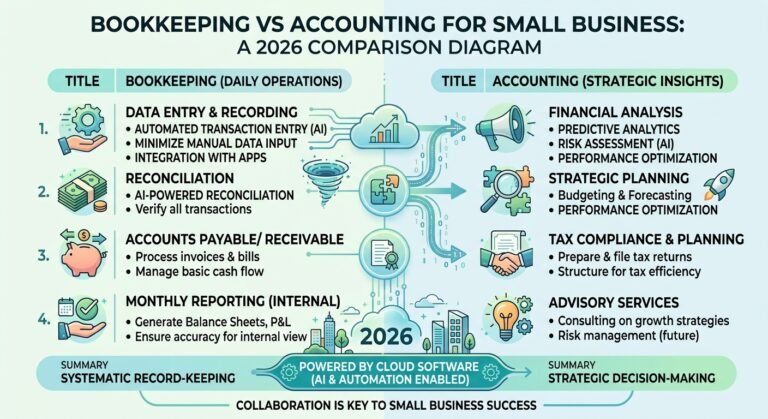

Small business bookkeeping Ontario owners often treat as an afterthought, right up until tax season or a CRA letter forces the issue. It does not have to be that way. Good books are mostly a set of simple habits done consistently, and once they are in place they save you money, stress and time. This guide covers eight basics that keep an Ontario business compliant and clear-eyed about its money.
Whether you are a sole proprietor or run a growing incorporated company, these are the foundations to get right first.
Why small business bookkeeping Ontario owners cannot skip it
Bookkeeping is the record of every dollar that moves through your business. Without it, you cannot file an accurate tax return, you cannot claim the expenses you are entitled to, and you cannot tell whether you are actually making money. The CRA can also ask to see your records, and “I lost the receipts” is not a defence that ends well.
Clean books also make everything else easier: applying for financing, bringing on a partner, or simply sleeping at night during a slow month because you know your real numbers.
8 bookkeeping basics every owner needs
Work through these in order and you will have a system, not a shoebox.
- Open a separate business bank account and card. Mixing personal and business spending is the single most common mistake, and untangling it later costs far more than avoiding it now.
- Record every transaction. Use cloud software so income and expenses are captured as they happen, with receipts attached, rather than reconstructed months later from memory.
- Keep your records for six years. The CRA requires you to hold supporting documents for six years from the end of the tax year they relate to. Digital copies are fine.
- Track HST separately. In Ontario you charge 13% HST once registered, and the tax you collect is not your money. Record it apart from revenue, and track the HST you pay on purchases so you can claim it back as input tax credits.
- Reconcile monthly. Match your books against your bank and credit card statements every month. Small errors caught early are minutes of work; the same errors found at year end can be days.
- Use a consistent chart of accounts. Categorize expenses the same way every time so your reports mean something. Guessing categories makes your financials useless for decisions.
- Stay ahead of remittances. If you have employees, payroll source deductions are due on a schedule, and HST filings come due on yours. Missed remittances draw penalties and interest quickly.
- Read your reports. Look at your profit and loss, balance sheet and cash flow each month. The point of bookkeeping is not the data entry, it is the picture it gives you.
Small business bookkeeping Ontario: cash versus accrual
Most Ontario businesses report income on an accrual basis, meaning you record a sale when you earn it and an expense when you incur it, not when the cash moves. Cash-basis accounting is simpler but is limited for tax purposes, mainly to certain farming and fishing businesses.
Accrual gives a truer view of how the business is doing, since a big invoice you have sent but not yet been paid for still shows up. For guidance straight from the source, the CRA explains the rules on its keeping records pages.
Common mistakes to avoid
The usual culprits are predictable. Owners run personal costs through the business account, let receipts pile up untracked, forget that collected HST is owed to the CRA, and keep doing their own books long after the business has outgrown a spreadsheet.
Each of these is fixable. The cost of ignoring them shows up as a rushed, expensive scramble every spring, and sometimes as penalties that were entirely avoidable.
Choosing your bookkeeping software
Most Ontario businesses land on QuickBooks Online or Xero, and both handle the basics well: bank feeds, invoicing, HST tracking and monthly reports. QuickBooks has the wider accountant network in Canada, while Xero is often praised for a cleaner interface and simpler pricing.
Whichever you choose, connect your business bank account so transactions import automatically, and set up your HST codes from day one. The tool matters far less than using it consistently.
Good software turns the small business bookkeeping Ontario owners once dreaded into a short weekly habit, and it hands your accountant clean data at year end instead of a rebuild.
Small business bookkeeping Ontario: common questions
How do I start small business bookkeeping Ontario the right way?
Open a separate business account, record every transaction in cloud software, and keep receipts for six years. Consistent small business bookkeeping Ontario habits matter far more than any single tool.
Can I do small business bookkeeping Ontario myself?
Many owners do at first. As HST, payroll and volume grow, small business bookkeeping Ontario gets easier to hand to a bookkeeper who can catch deductions and avoid penalties.
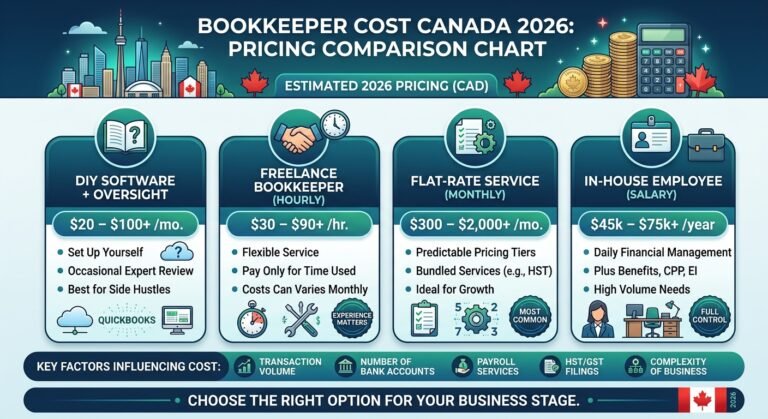
How much does small business bookkeeping Ontario cost?
It varies with transaction volume and services. The return usually comes from claimed deductions and avoided CRA penalties, which is why small business bookkeeping Ontario tends to pay for itself.
When to hire a bookkeeper
Bring in help when the books start eating time you should spend serving customers, when HST or payroll adds complexity, or when you are growing fast enough that a mistake gets expensive. A good bookkeeper usually pays for themselves in claimed deductions, avoided penalties and hours returned to you.
Corporate Empire offers a free 15-minute books review for Ontario owners who want a straight answer about where they stand. Start on the Corporate Empire homepage, or reach us through our contact page. For HST specifics, the CRA’s GST/HST for businesses hub is the official reference.