
Corporate tax filing Ontario owners face every year is more forgiving when the books are clean and the deadlines are mapped out ahead of time. The T2 return has its own rhythm, separate from personal taxes, and missing a date costs real money in interest and penalties.
This guide covers when your return and payment are due, how the small business deduction works, and the CRA traps that catch incorporated owners. Planning in the fall gives you room to act before anything is due.
What corporate tax filing Ontario companies must do
Corporate tax filing Ontario corporations handle starts with the T2 return, which every incorporated business files regardless of whether it made a profit. A dormant company with no income still files.
The return reports your income, expenses, and the tax you owe at both the federal and provincial level. Ontario corporate tax is collected together with federal tax through the single T2 return.
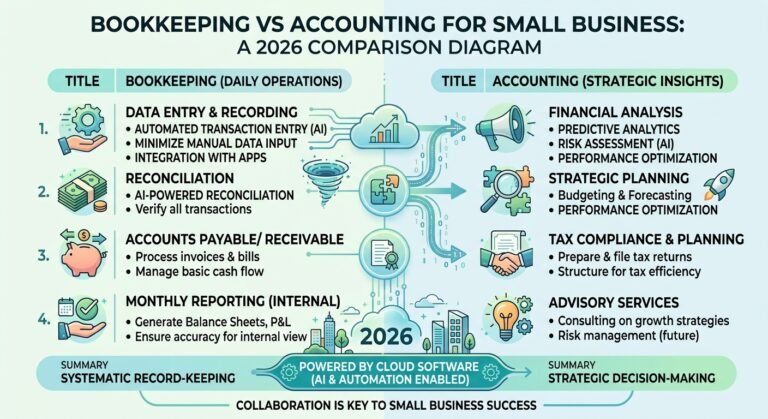
Behind the return sits your bookkeeping. Accurate records through the year are what make the filing quick and the result defensible if the CRA ever asks questions.
T2 deadlines you cannot miss
Your T2 return is due within six months of your fiscal year-end. A December 31 year-end means the return is due by June 30.
Payment runs on a tighter clock than the return. The balance owing is generally due two months after year-end, which trips up owners who assume the filing date and the payment date are the same.
Canadian-controlled private corporations claiming the small business deduction, and meeting the conditions, get three months after year-end to pay the balance. The CRA sets out these dates on its site, available on Canada.ca.
The small business deduction and your rate
The small business deduction lowers the tax rate on the first portion of active business income for a qualifying Canadian-controlled private corporation. For most small Ontario companies, this is the single biggest lever on the tax bill.
The combined small business rate in Ontario is far below the general corporate rate. Keeping your income within the limit, and keeping it as active business income rather than passive investment income, protects that lower rate.
Passive investment income above a threshold can grind down your access to the small business deduction. If your corporation holds investments, this is worth reviewing with your accountant before year-end.
Watch the personal services business trap
A personal services business, or PSB, is when the CRA treats an incorporated contractor as if they were really an employee of the client. It is a growing area of CRA attention.
If most of your corporation’s income comes from one client, and you would look like their employee without the corporation in between, you may be at risk. A PSB loses the small business deduction and most expense deductions, which sharply raises the tax.
The CRA has expanded digital matching across T-slips, payroll, and GST/HST, so mismatches are easier for them to spot. Structuring contracts and work arrangements carefully is the defence here.
Expenses incorporated owners often miss
Home office costs, a reasonable portion of vehicle expenses, and professional fees are commonly underclaimed. Each needs records to support it, which is another reason clean books matter.
Owner compensation is its own decision. The split between salary and dividends changes your tax, your CPP, and your RRSP room, so it is worth planning rather than defaulting.
Capital purchases are deducted over time through capital cost allowance rather than all at once. Getting the classes right affects your return, and the standards body CPA Canada is a useful reference on the rules.
How to make corporate tax filing Ontario simple
Keep your bookkeeping current through the year. A set of reconciled monthly books turns tax time into a review instead of a reconstruction.
Map your dates now. Write down your year-end, your payment deadline, and your filing deadline, then set reminders well ahead of each.
Talk to an accountant before year-end, not after. Most tax planning, including salary-versus-dividend and timing of purchases, only works if you act before the year closes.
Common questions about corporate tax in Ontario
When is my T2 return due?
Within six months of your fiscal year-end. A December 31 year-end means the return is due by June 30 the following year.
Is the payment deadline the same as the filing deadline?
No, and this catches many owners. The balance is generally due two months after year-end, or three months for a qualifying CCPC claiming the small business deduction.
Do I still file if my company made no money?
Yes. Every incorporated business files a T2, even a dormant one with no income or activity for the year.
What is a personal services business and why does it matter?
It is when the CRA treats an incorporated contractor as an employee of their main client. A PSB loses the small business deduction and most expense claims, which raises the tax sharply.
Plan your filing before the deadline arrives
The owners who find corporate tax filing Ontario painless are the ones whose books are reconciled and whose deadlines are already on the calendar. Everything downstream gets easier from there.
Corporate Empire handles bookkeeping and corporate tax support for Ontario businesses, including T2 preparation and year-end planning. You can book a free consultation to review your books and your deadlines before anything is due.