Owners use the words interchangeably, but bookkeeping and accounting are two different jobs, and knowing which you need saves money. The bookkeeping vs accounting question comes down to this: one keeps an accurate daily record of your money, and the other interprets that record to guide decisions and file your taxes. This guide explains what each does, where they overlap, what they cost, and which your small business should hire first.
What a bookkeeper does
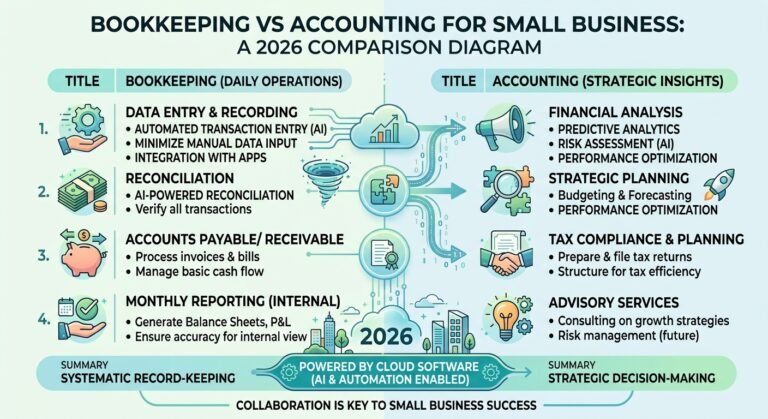
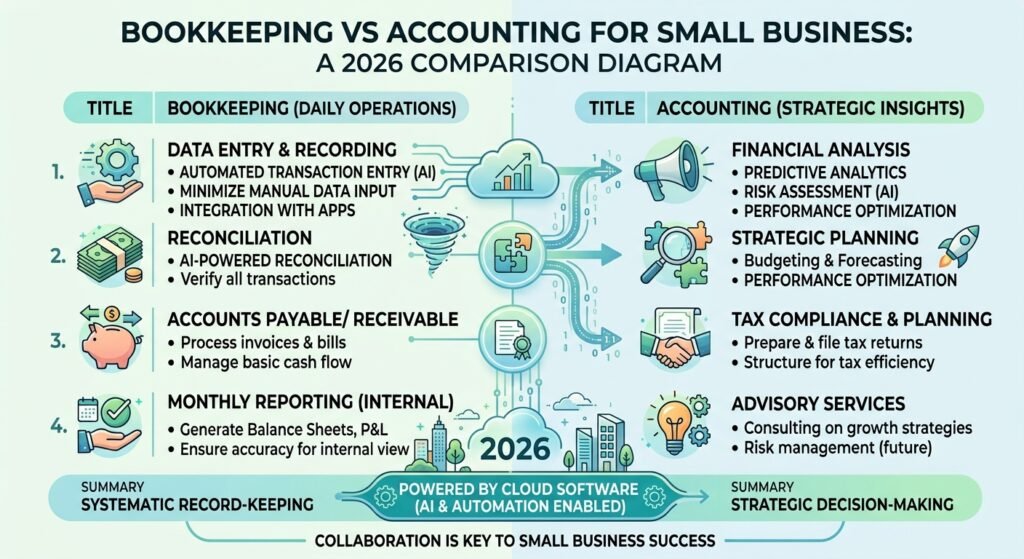
Bookkeeping is the day-to-day work of recording your financial activity accurately. A bookkeeper enters and categorizes every transaction, reconciles your bank and credit card accounts, tracks who owes you money and who you owe, runs payroll, files your HST, and produces monthly reports like a profit-and-loss statement. The goal is a clean, current, reliable set of books. Everything else depends on this foundation, which is why the bookkeeping vs accounting split always starts here.
What an accountant does
Accounting takes the finished books and turns them into insight and compliance. An accountant reviews your statements, advises on tax strategy, prepares and files your corporate or personal tax returns, handles year-end adjustments, and helps with bigger decisions like whether to incorporate or how to structure an owner’s pay. Where a bookkeeper records what happened, an accountant explains what it means and keeps you compliant with the CRA. In Canada, a CPA designation signals the higher level of training that this work calls for.
Where they overlap
The line is not always sharp. Many bookkeepers prepare financial statements and handle HST, and many accountants will do or oversee bookkeeping for smaller clients. Cloud software has blurred the bookkeeping vs accounting divide further, since the same QuickBooks or Xero file flows from the bookkeeper straight to the accountant at year-end. The practical point is that the two roles work best together: good bookkeeping makes accounting faster and cheaper, because the accountant is not fixing messy records before they can do the valuable work.
Side by side
| Bookkeeper | Accountant | |
|---|---|---|
| Main job | Record and organize transactions | Interpret, advise, file taxes |
| Frequency | Daily, weekly or monthly | Quarterly and at year-end |
| Typical output | Reconciled books, P&L, HST returns | Tax returns, tax planning, financial analysis |
| Credential | Certified bookkeeper (CPB) | CPA |
| Relative cost | Lower | Higher |
What each costs
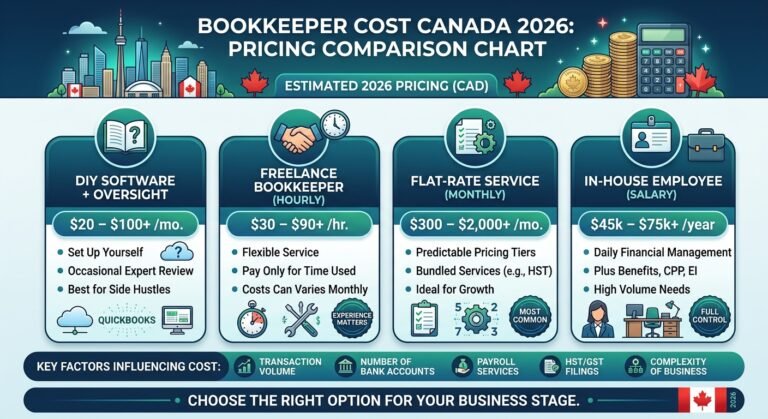
Because the work is different, so is the price. Bookkeeping is usually billed as a monthly fee, commonly a few hundred dollars for a small business, or an hourly rate. Accounting is billed at a higher hourly rate or a project fee for tax filing and planning, reflecting the training involved. In the bookkeeping vs accounting trade-off, the money-saving move is to keep routine recording with a bookkeeper and reserve your accountant’s higher rate for strategy and filing, rather than paying a CPA rate to categorize receipts.
Which does your small business need first?
Almost every small business needs bookkeeping first. Without accurate books, an accountant has nothing solid to work from, and you cannot see how your business is really doing month to month. Start with reliable bookkeeping, then bring in an accountant for year-end taxes and planning once there is a clean record to act on. As you grow, add payroll, more frequent reporting, and deeper tax strategy. If managing your own HST is part of the question, our GST/HST guide for Ontario covers that piece in detail.
Getting the mix right
The bookkeeping vs accounting decision is not either-or. Most healthy small businesses use both: a bookkeeper to keep the records clean and current, and an accountant to file and advise. Getting the split right means you pay the right rate for the right work and never scramble at tax time. You can check credentials through CPB Canada for bookkeepers and CPA Ontario for accountants. If you want the bookkeeping side handled so your accountant gets clean books at year-end, see our bookkeeping services.